
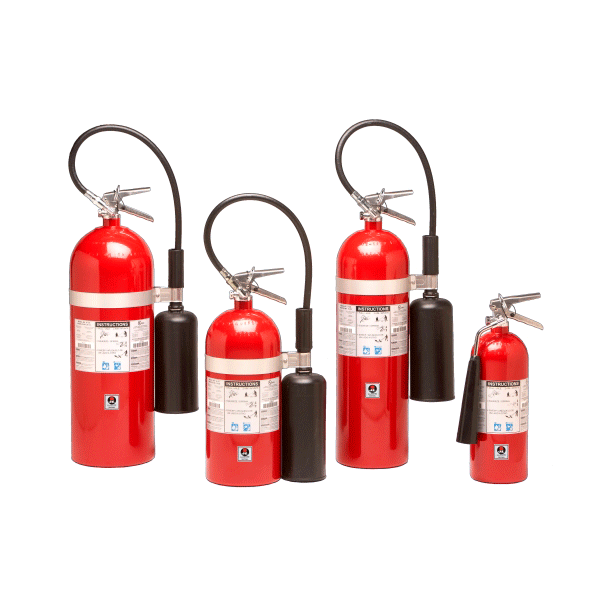
The Sentinel Carbon Dioxide Fire Extinguisher contains pressurized liquid carbon dioxide. Carbon dioxide is a trusted, non-conductive, clean agent that works well on electrical equipment fires. In many settings, this fire extinguisher is typically found in data centers, offices, classrooms, retail, and research facilities.
It is also available in an MR-conditional non-magnetic fire extinguisher for MRI Rooms.
- Sentinel Carbon Dioxide Fire Extinguisher is available in 5 lb., 10 lb., 15 lb., and 20 lb.
- Sentinel Non-Magnetic, MR-Conditional Fire Extinguisher is available in 5 lb.
- Fights Class B (Flammable Liquids and Gases) and Class C (Electrical Conductivity) fires.
Sentinel Carbon Dioxide Fire Extinguisher Specifications
- Conforms to Test Standards: CAN/ULC-S503, ANSI/UL154 & CAN/ULC-S508-ANSI/UL711. Non-magnographic extinguishers were also tested on 11.7 Tesla or less.
- Operation: Squeeze the lever to open the valve and release the carbon dioxide. The discharge, which changes into a gas and appears as a smothering cloud of white snow, is then directed to the fire through a funnel-shaped horn. It is electrically non-conductive.
- Temperature Range: -22° F (-30° C) to 120° F (49° C)
- Construction: Lightweight, high-pressure aluminum cylinder with O-ring seal and straight-thread brass valve; fits all sizes. The Sentinel is rust-free and up to 30% lighter than CO2 units with steel cylinders.
- Construction: Non-magnetic, lightweight, high-pressure aluminum cylinder with O-ring seal and straight-thread chrome-plated brass valve. The Sentinel is rust-free and up to 30% lighter than CO2 units with steel cylinders.
- Note: Each fire extinguisher includes one standard bracket (J-Hook).
Available Sizes
- Sentinel 5 (FS05C) 5 lbs. Nominal Capacity
- Sentinel 10 (FS10C) 10 lbs. Nominal Capacity
- Sentinel 15 (FS15C) 15 lbs. Nominal Capacity
- Sentinel 20 (FS20C) 20 lbs. Nominal Capacity
Classes of Fire Protection
Class A Fires – Ordinary Combustibles
Additionally, these fires are typically extinguished with water or dry chemical agents that cool and insulate the burning material. Class A fires involve common combustible materials such as:
- Paper
- Wood
- Cloth
- Cardboard
- Trash
Class B Fires – Flammable Liquids & Gases
For these fires, extinguishers must smother flames and interrupt the fire’s chemical reaction. Class B fires involve flammable and combustible liquids, including:
- Gasoline
- Oil
- Paints
- Solvents
- Grease
Class C Fires – Electrical Equipment
Non-conductive fire extinguishing agents are essential for safely suppressing electrical fires without increasing the risk of electric shock. Class C fires occur in energized electrical equipment, such as:
- Electrical panels
- Wiring
- Computers
- Machinery
- Appliances
Class K Fires – Cooking Oils & Grease
These specialized fire extinguishers are designed to suppress grease fires and help prevent re-ignition quickly. Class K fires involve high-temperature cooking oils and grease commonly found in:
- Commercial kitchens
- Restaurants
- Food service facilities
Click here to learn more about choosing a suitable fire extinguisher and fire extinguisher cabinet.
Contact us for more information on fire extinguishers.